Mistakes of the Year: How to Use Them for Company's Growth
Every mistake in a company is a chance to reassess business processes and foster the faster growth. Learn how to effectively analyze failures and learn from them with your team.

Regardless of business size or focus, companies often make the same mistakes: financial missteps, marketing goofs, technical malfunctions, and personnel errors. Mistakes are normal and natural. The key is not to ignore your mistakes but to thoroughly address each one. Here's what you can do if you've made quite a few mistakes this year.
Analyze the Mistakes
Start by listing all significant mistakes made over the year. You can discuss with your team what went wrong and brainstorm solutions, or conduct an internal audit of your business processes, gathering data on sales, profits, marketing activities, and employee key performance indicators. Once the main errors are identified and documented, it's essential to understand why they occurred.
Tools and Methods to Identify Causes of Failures
Sometimes it's not immediately clear why a negative situation occurred. In such cases, special tools can be helpful. Let's explore them in more detail.
The Five Whys Method
The main goal of this method is to identify the root cause of a problem. You need to sequentially ask "why" and each new answer should help delve deeper into the circumstances and get closer to the root of the negative situation. Usually, five "whys" are enough to uncover the truth, but sometimes more repetitions of the same question are needed.
Fishbone Diagram
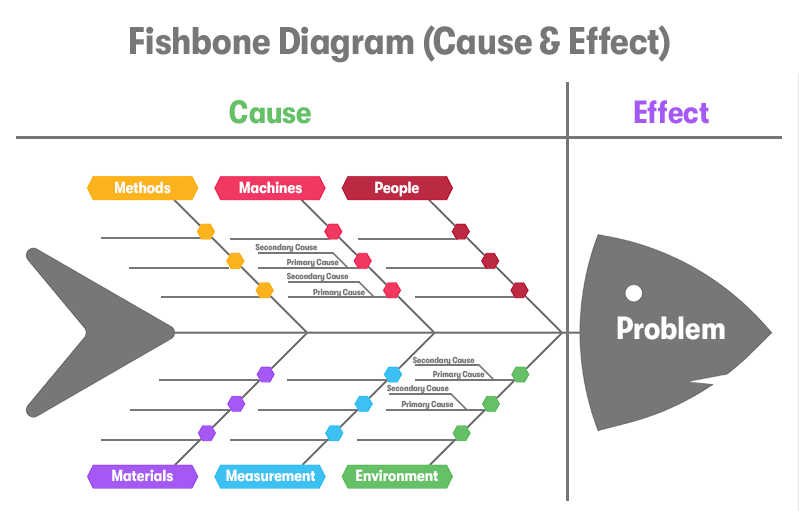
Also known as Ishikawa Diagram, this helps find and visualize the cause of failure. The diagram is schematically drawn as a fish skeleton, where the "head" is the problem and the "bones" are factors influencing the situation.

Agile Retrospectives
In the Agile approach for flexible project management, retrospectives are short meetings held at the end of each sprint—a time frame when the team focuses on specific tasks. In these retrospectives, all employees discuss the sprint’s progress and what needs to be done to improve future work. You can organize a series of such meetings at the end of the year, categorizing mistakes and holding separate retrospectives to discuss them with the team.
Learn the Lessons
Once you have identified mistakes and their causes, it's important to reflect—evaluate what happened and understand what lessons can be drawn. Here are some formats you can use:
- Brainstorming — Organize a meeting where the team can freely share ideas about what went wrong and how processes can be improved. Prohibit criticism of ideas during the discussion and record all suggestions;
- Anonymous Surveys — Create an anonymous survey to gather employee suggestions, ensuring that no colleagues are afraid to share their ideas.
- Hot Seat — Each team member takes turns on the "hot seat," while others ask about how a specific mistake could have been avoided and what needs work. Record all statements and use a timer to speed up the process, which encourages creativity.
The insights gained should form the foundation of a new company development strategy for the next year.

Apply Acquired Knowledge
Based on the analysis conducted and lessons learned, it's necessary to reassess your company’s goals and establish new ones for the coming year. Here’s a step-by-step plan you can follow.
Step 1. Set New Goals Using the SMART Method
Your new goals should be:
- specific — what exactly you want to achieve.
- measurable — how you will measure success.
- achievable — whether these goals are realistic.
- relevant — if they align with the overall business objectives.
- time-bound — when you plan to achieve these goals.
Step 2. Create a Goals Map
Create a visual map with your main goals for the year, each linked to specific lessons and conclusions from the analysis.


Step 3. Outline an Action Plan
Detail the steps to achieve your goals. For each goal, develop a detailed action plan:
- What needs to be done specifically?
- Who will be responsible for task completion?
- What resources will be required?
- When will the task be completed?
Step 4. Define KPIs and Create a Progress Monitoring System
Set key performance indicators (KPIs) for each goal to understand success indicators. Here are some metrics you can use:
- sales volume;
- percentage of sales plan completion;
- number of positive customer reviews;
- customer retention rate;
- support response time;
- percent of error-free orders completed;
It's important to regularly monitor the achievement of set goals, identify "pain points," and find areas for improvement. Special tools and methods can be used to monitor company results.
Project Management Tools. Platforms like Asana, Trello, and Jira allow you to track task completion, monitor deadlines, and assess work results.
Performance Reports. Tools like Google Sheets and Microsoft Excel enable you to create reports and track employee achievements.
Business Analytics Tools. Tableau and Power BI help gather data from various sources and visualize it in the form of interactive reports and dashboards to monitor key performance indicators in real-time.
The choice of tools depends on the business specifics, company budget, and functionality requirements. It’s essential not only to establish monitoring systems but also to regularly analyze the collected data and draw conclusions from it.

Boost Team Morale
After analyzing mistakes and discussing failures, it's crucial to uplift colleagues and motivate them for new achievements. A great way to wrap up the work year could be playing Secret Santa. This game helps lighten the atmosphere and bring a festive mood to everyone, even those upset by a number of errors.
The game's main goal is to anonymously exchange Christmas gifts. Each participant becomes a Santa who secretly prepares a gift for another player. As a result, everyone receives delightful emotions from the celebration and a gift.
To start the game, employees draw names to determine who gives a present to whom. On the day set for discussing the year's mistakes, ask everyone to bring their prepared gifts. Collect them in one place, and then at the end of the meeting, ceremonially present each surprise.
Quickly organize the game with the MySanta service. It automatically assigns participants, preventing confusion during the draw. No one will forget their recipient's name since a notification about the gift recipient will be sent via email or message.
Additionally, you can chat with your Santa anonymously, create wishlists, and explore gift ideas in a shop. There's an option to manage the game process: track gift status, add exceptions, and remind forgetful Santas to buy a gift on time.